







I hope you enjoy reading this blog post. If you want my team to help you grow your business,
click here.
Offshore software development services have fundamentally transformed from cost-cutting measures into strategic imperatives for organizations seeking competitive advantage in 2026. Enterprises increasingly leverage global talent pools not merely for financial benefits but to access specialized expertise otherwise unavailable domestically.

The strategic value of offshore software development extends well beyond basic labor arbitrage. Software development outsourcing now represents a sophisticated operational model that enables organizations to distribute technical capabilities across optimal global locations. While offshore development pros and cons must be carefully evaluated, mature organizations recognize that offshore development services provide more than just cost advantages; they deliver specialized technical capabilities, accelerate time-to-market, and enable resource flexibility.
This comprehensive guide examines the evolving landscape of offshore partnerships for executive decision-makers. Specifically, it addresses the critical factors CEOs must consider when evaluating offshore strategies, including talent acquisition, risk management, governance frameworks, and operational integration. Furthermore, it provides structured assessment models to determine when offshore models deliver maximum strategic value versus when nearshore or onshore alternatives prove more advantageous.
1. What Offshore Software Development Really Means in 2026
In 2026, offshore software development represents far more than relocating coding tasks to distant countries. It has evolved into a sophisticated operational strategy where organizations partner with remote tech teams across borders to build, maintain, or scale software products, tapping into global excellence rather than simply cutting costs.
2. Definition and evolution of offshore development
The offshore software development market stands at approximately $198.30 billion in 2026, with projections to reach $413 billion by 2033. This remarkable growth reflects how dramatically the model has transformed over the decades.
Offshore development initially emerged as a transaction-based approach where work was broken down into isolated tasks executed elsewhere with minimal context. This early model suffered from quality issues, poor predictability, and high transaction costs. As one industry analysis notes, “Just reducing complex things to transactions is a daunting task, and results can hardly be expected to be very good”.
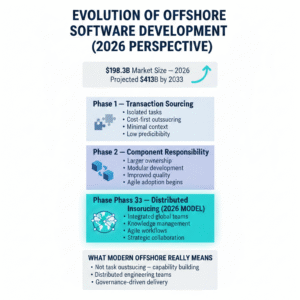
The evolution progressed through three distinct stages:
- Transaction sourcing: Low-efficiency outsourcing focused solely on cost reduction
- Component responsibility: Entrusting entire components to offshore teams with improved quality
- Distributed insourcing: Today’s model of fully-fledged cooperation with remote teams as integral parts of organizations
Consequently, modern offshore development emphasizes knowledge management, team ownership, and agile methodologies, creating what many now call “distributed insourcing” rather than traditional outsourcing.
3. How offshore differs from nearshore and onshore
The three primary software development models differ in several crucial aspects:
Offshore development involves teams in distant countries, often with significant time zone differences (6-12 hours). It offers maximum cost savings and access to vast talent pools but requires careful management of cultural and communication differences.
Nearshore development involves teams located in neighboring countries or those in similar time zones, typically on the same continent. This model offers moderate cost benefits, along with easier real-time collaboration.
Onshore development keeps teams within the same country, offering complete time zone alignment and cultural similarity, but at the highest cost.
In practice, many organizations now implement hybrid models that combine these approaches, seeking an optimal balance between cultural similarity, time zone overlap, and round-the-clock efficiency.
4. Why CEOs are rethinking offshore in 2026
For executives, offshore development has shifted from a tactical cost-cutting measure to a strategic capability. Indeed, 34% of companies still cite cost reduction as their primary motivation. Nevertheless, more sophisticated factors are driving adoption:
Access to specialized expertise: 92% of companies cite talent access as a key driver, particularly as domestic skills gaps intensify, with 74% of employers reporting difficulty filling specialized roles.
Business continuity and flexibility: Organizations report a 10% year-over-year improvement in business continuity through global distribution, with offshore teams enabling uninterrupted service delivery.
Accelerated time-to-market: The “follow-the-sun” development model creates round-the-clock productivity, reducing overall development duration. Teams across time zones ensure continuous progress even while domestic teams sleep.
Enhanced innovation capacity: Perhaps most importantly, organizations recruiting across borders position themselves better for continued growth and adaptation under ongoing skills shortages.
Above all, the strategic shift from “payment for hours” to outcome-driven models is accelerating as organizations seek partners invested in business results rather than billable time.
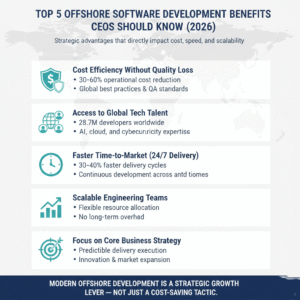
5. Top 5 Benefits CEOs Should Know
Beyond strategic advantages, offshore software development delivers concrete business results that directly impact your bottom line. For CEOs navigating today’s competitive landscape, these five benefits stand out as particularly valuable.
4.1. Cost savings without compromising quality
One of the most compelling reasons to consider offshore development is substantial cost efficiency. Companies can reduce operational costs by 30-60% when outsourcing to countries with lower living costs. This difference isn’t merely about hourly rates; it represents a fundamental financial advantage that impacts your entire business model.
A cybersecurity analyst in the United States might command a six-figure salary, whereas equally skilled professionals in offshore locations are available at a fraction of the cost. These savings extend beyond salaries to include reduced infrastructure investment, training, and compliance processes. Notably, these cost advantages don’t necessarily come at quality’s expense, many offshore providers follow global best practices, including agile methodologies and robust QA processes.
The strategic value lies in reinvestment potential. Rather than treating offshore development solely as a budget measure, forward-thinking businesses redirect savings toward innovation, market expansion, and customer experience.
4.2. Access to global tech talent
Finding specialized technical skills locally has become increasingly difficult, with 74% of employers reporting challenges filling specialized roles. Offshore development solves this problem by providing immediate access to a global talent pool of 28.7 million developers.
India alone has approximately 5.8 million software developers, giving companies access to expertise that may be scarce or prohibitively expensive domestically. Vietnam, meanwhile, produces 57,000 tech graduates annually, creating a continuously refreshed talent pipeline.
Most importantly, offshore partnerships eliminate the typical 42-day recruitment process, allowing companies to onboard skilled teams in as little as 7 days to meet urgent technical needs. This advantage becomes especially critical for specialized areas experiencing rapid demand growth, such as AI/ML engineering (58% increase), cybersecurity (41% gap), and cloud architecture (33% needs).
4.3. Faster time-to-market through 24/7 cycles
The “follow-the-sun” development model represents one of the most significant advantages of offshore partnerships. By distributing work across time zones, development continues even after your local team logs off. This approach compresses overall timelines without adding pressure on internal employees.
For instance, a U.S. team can push updates during their workday, and while they rest, offshore counterparts in Asia continue coding, testing, or debugging. This continuous workflow can reduce project timelines by 30-40%, allowing companies to deploy and patch faster.
One fintech startup leveraged offshore teams to launch a payment app in just six months, compared to the typical one-year timeline. This accelerated time-to-market is particularly valuable in industries where early market entry determines success.
4.4. Scalable teams for changing needs
Offshore development provides unmatched flexibility to adjust resources based on business requirements. Companies can scale teams up or down with ease, avoiding lengthy hiring processes and expensive overhead commitments.
This scalability allows businesses to respond quickly to market demands without long-term payroll commitments or internal restructuring. For seasonal spikes, major product launches, or new software rollouts, offshore teams provide the infrastructure to expand capacity quickly without the costs or risks of permanent headcount increases.
One SaaS startup doubled its engineering capacity in just two months using offshore developers, ensuring an on-time product launch. For growing companies, this ability to maintain lean operations while supporting aggressive roadmaps is invaluable.
4.5. Focus on core business while outsourcing tech
Possibly the most underrated benefit of offshore development is how it frees leadership to concentrate on strategic priorities. When execution becomes predictable, leadership focus shifts from managing delivery risks to enhancing customer experience, product vision, and market expansion.
By outsourcing technical development, internal teams can redirect attention to areas where they provide the most value, whether that’s strategic planning, business growth, or customer engagement. This division of responsibilities leads to greater overall efficiency and enables more thoughtful allocation of resources.
For many growing companies, this operational breathing room creates space for better decision-making and long-term growth planning. According to industry experts, this benefit is less visible but often delivers the most substantial strategic value over time.
5. Risks That Can Derail Offshore Projects
Despite the attractive advantages, offshore software development comes with significant challenges that can derail even the most promising projects. Understanding these risks beforehand helps CEOs implement effective mitigation strategies.

Time zone and scheduling conflicts
When teams operate across different time zones, simple decisions can stretch into multi-day exchanges. A question raised at the end of one team’s workday might stall an entire sprint until someone wakes up to respond. Moreover, different countries observe distinct holidays and cultural traditions that can cause unexpected project delays if not properly accounted for. Even a one-hour time difference can lead to an 11% decrease in real-time communication, ultimately extending development cycles and increasing operational costs.
Communication and cultural barriers
Communication complexity increases dramatically with geographical distance. Language barriers, cultural differences, and varying communication styles create misunderstandings that directly impact project outcomes. In fact, 73% of offshore projects struggle due to inadequate communication, creating bottlenecks that undermine the entire operation. Additionally, cultural differences influence 25-50% of our attitudes and are among the five key risk areas identified by Gartner for offshore projects.
Quality assurance and delivery issues
Without robust standards and oversight mechanisms, offshore QA teams may adopt inconsistent testing methodologies or documentation practices. Over 60% of organizations implementing offshore quality assurance experience issues traceable to insufficient oversight and unclear expectations. Furthermore, inadequate access to development environments, testing tools, and collaborative platforms hampers productivity and reduces testing effectiveness.
Legal and IP protection concerns
Intellectual property protection should be your top priority when outsourcing software development. According to the U.S. Intellectual Property Commission, IP theft costs U.S. businesses over $600 billion annually. Many outsourcing hubs appear on watch lists for IP rights violations, and offshore vendors with weak internal controls may reuse code for other clients or employ shadow developers not bound by NDAs. Plus, local courts in offshore locations may not recognize or prioritize foreign NDAs.
Team disengagement and lack of ownership
The commitment of an outsourced team is rarely the same as that of internal employees. Offshore team members often receive tasks without full context, leading to assumptions that don’t match stakeholder expectations. This lack of shared understanding is one reason why offshore projects fail to deliver value. Eventually, this creates disengagement, higher turnover rates, and reduced accountability, as it becomes difficult for executives to assess whether offshore teams are operating at peak efficiency.
6. Best Practices for Offshore Success
Success with offshore software development hinges on several critical practices that prevent common pitfalls. Executives who implement these strategies consistently report higher satisfaction and better outcomes from their global partnerships.
Choose the right offshore partner
The foundation of successful offshore development begins with finding partners who understand your specific technical landscape. Seek providers with proven experience in your technology stack and the ability to deliver software predictably. The best partners act as strategic contributors who help plan future investments rather than just completing assigned tasks. Naturally, cultural fit becomes essential, look for teams that demonstrate proactive problem-solving and can respectfully challenge assumptions when necessary.
Define scope, KPIs, and timelines clearly
Effective offshore projects require well-defined objectives and measurable success metrics. Organizations should identify appropriate Key Performance Indicators (KPIs) to gain valuable insights into project progress. Additionally, documentation of requirements, architecture specifications, and communication protocols helps prevent ambiguity. Breaking projects into smaller milestones creates natural checkpoints for quality reviews throughout the development lifecycle.
Use agile methods and collaboration tools
Offshore teams benefit significantly from agile frameworks like Scrum or Kanban that provide structure across distances. Tools like Slack and Microsoft Teams enable real-time communication, yet become noisy without well-defined guidelines. For project management, Jira helps track sprint velocity and cycle time, crucial metrics for offshore teams. Version control systems such as GitHub and GitLab allow effective code collaboration despite working across borders.
Establish regular check-ins and reporting
Structured communication prevents issues from festering in offshore relationships. Daily standups help teams share progress and flag obstacles early, although these don’t necessarily need to involve entire teams across shores. Regular showcases where offshore developers demonstrate new features via remote desktop software help identify miscommunications quickly. Whenever possible, start conference calls with casual conversation about local news to build rapport.
Foster cultural alignment and team integration
Cultural alignment directly affects communication clarity, decision-making speed, and execution quality. Begin with a relationship-based approach rather than a transactional view. Send ambassadors between locations early in projects to facilitate communication and build personal connections. These ambassadors communicate not just formal information but valuable “gossip” that helps teams understand context. Through shared operating norms and expectations, offshore teams integrate smoothly and deliver consistent outcomes.
7. How to Decide Between Offshore, Nearshore, and Onshore
Choosing the right development model requires balancing several critical factors that directly impact project success. The decision between offshore, nearshore, and onshore is less about finding a universal solution and more about aligning with your specific business priorities.
Cost vs. control: what matters more?
First and foremost, offshore development offers the most significant cost savings, typically 30-60% lower than onshore options. Conversely, onshore development provides the highest level of control over critical activities and faster decision-making. The key question becomes: does your project prioritize budget efficiency or hands-on management? For businesses with larger budgets and strict regulatory needs, onshore development may justify its premium cost.
Communication ease and time zone overlap
Time zone alignment directly impacts collaboration efficiency. With offshore teams, you may have only a tiny window for real-time communication, potentially creating an 11% decrease in effective collaboration. Nearshore options strike a balance with partial or full time zone overlap, while onshore eliminates this challenge entirely.
Talent availability and specialization
Offshore regions like India and the Philippines offer access to vast talent pools for specialized roles and rapid scaling. Certainly, this global reach provides solutions for technical skills that might be scarce domestically. Onshore teams, in contrast, offer market-specific knowledge but may limit access to specialized expertise.
Legal and compliance considerations
Intellectual property protection should be a primary concern when selecting an outsourcing model. Onshore development provides the highest level of legal clarity, with straightforward IP protection and data compliance. Given these points, regulated industries often prefer onshore or nearshore models where legal frameworks are more familiar.
When hybrid models make sense
Many organizations now implement a combined approach, keeping core strategy onshore, real-time tasks nearshore, and development offshore. This structured mix optimizes costs while maintaining control across different project phases. With this in mind, hybrid models allow businesses to maintain a firm grip on core operations while delegating specific tasks to external teams.
Conclusion
Offshore software development has clearly evolved beyond its initial role as a cost-cutting strategy. Organizations now view it as a vital competitive advantage that provides access to global talent, accelerates product delivery, and enables operational flexibility. Nevertheless, success depends on careful consideration of the associated risks alongside implementation of structured governance practices.
The decision between offshore, nearshore, and onshore models requires thoughtful analysis of your specific business priorities. Cost advantages must be balanced against communication needs, control requirements, and compliance considerations. Many successful companies therefore, adopt hybrid approaches, strategically distributing different aspects of development across global locations to maximize benefits while minimizing drawbacks.
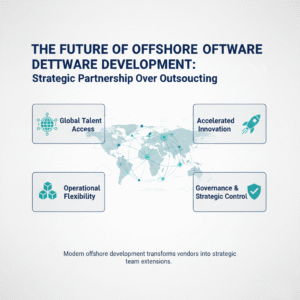
Executives who approach offshore development as a strategic partnership rather than a transactional relationship generally achieve superior outcomes. This means investing time in selecting the right partners, establishing clear metrics, implementing appropriate collaboration tools, and actively building cross-cultural understanding. The most successful offshore relationships ultimately transform from vendor arrangements into seamless team extensions.
Technology leaders face growing pressure to deliver innovation at unprecedented speeds while managing limited budgets. Offshore development, when executed properly, offers a compelling solution to this challenge. Companies that master global software development position themselves to thrive amid talent shortages, market fluctuations, and competitive pressures. The future belongs to organizations that can effectively harness worldwide expertise while maintaining a cohesive vision and execution across borders.
FAQs
What is an offshore software development company?
An offshore software development company is a technology partner that provides engineering, testing, or product delivery services from a different country, typically where specialized talent is more accessible and operational costs are lower. Unlike freelance outsourcing, offshore providers usually deliver structured teams that include developers, QA engineers, project managers, and architects. Modern offshore companies act as long-term strategic partners, helping organizations scale engineering capacity, accelerate delivery timelines, and access global expertise while maintaining governance and quality standards.
How much do offshore software engineers make?
Offshore software engineer salaries vary significantly depending on region, seniority, and specialization. In major outsourcing hubs such as India, Vietnam, Eastern Europe, or Latin America, mid-to-senior engineers typically earn 30–70% less than their counterparts in North America or Western Europe. For example, while a senior engineer in the United States may cost over six figures annually, offshore engineers with similar technical capabilities often range from $30,000 to $80,000 per year depending on experience and local market conditions. These differences allow companies to scale teams more efficiently without compromising technical quality.
Why choose offshore software development?
Organizations choose offshore software development to gain strategic advantages beyond simple cost reduction. Key benefits include access to a broader global talent pool, faster time-to-market through distributed 24/7 workflows, and the ability to scale engineering teams quickly without long hiring cycles. Offshore partnerships also enable companies to focus internal resources on core business priorities while external teams handle technical execution. When managed properly, offshore development becomes a growth strategy that supports innovation, operational flexibility, and long-term competitiveness.
How to manage offshore software development?
Successful offshore management requires clear governance, structured communication, and well-defined performance metrics. Companies should begin by selecting partners with proven domain expertise and establishing KPIs related to delivery speed, quality, and collaboration. Agile methodologies, shared project tools, and scheduled overlap hours help maintain alignment across time zones. Regular check-ins, transparent reporting, and strong documentation practices reduce misunderstandings and improve accountability. Most importantly, organizations that treat offshore teams as integrated extensions of their internal workforce, rather than external vendors, tend to achieve the strongest outcomes.

![Read more about the article Software Consultant Guide: What They Do & Why You Need One [2026]](https://pods365.com/wp-content/uploads/2026/01/Software-Consultant-Guide-2026-cover-300x169.png)