





Software development cost planning fails more often than most technology leaders anticipate, with only 35% of IT projects delivered on time and within budget. In 2026, organizations face a strategic reality: the initial build represents merely 20-50% of a project’s lifetime investment. Understanding how much does software development cost requires analyzing hourly rate structures, regional variations, and complexity tiers that directly influence architectural decisions. This guide provides a software development cost breakdown across US markets, from $80K business applications to $2M+ enterprise systems. Leaders will find custom software development cost estimates by team composition, compliance overhead, and hidden expenses that determine long-term scalability and operational risk.

1. Why are software development costs in the USA are higher in 2026
The median annual wage for software developers reached $133,080 in May 2024, reflecting market pressures that extend beyond simple supply and demand. The reached $133,080 in May 2024, reflecting market pressures that extend beyond simple supply and demand. The shortage of developers in the US will exceed 1.2 million by 2026, creating an unrealized economic output of $162 billion. This scarcity fundamentally alters software development cost estimates across all project types.
1.1. High demand for specialized developers
Tech vacancies remain open for an average of 35 days, with 1.4 million unfilled positions currently in the market. Companies compete aggressively for engineers skilled in AI, cloud architecture, and modern frameworks like React and Python. Major employers including Google, IBM, and Meta continuously recruit top talent, leaving smaller organizations to increase budgets or consider alternative staffing models. Employment projections show 15% growth from 2024 to 2034, generating approximately 129,200 annual openings. Senior specialists command salaries exceeding $150,000, with AI and machine learning experts reaching $250,000 annually.
1.2. Regional cost of living differences
Geographic location significantly influences software development cost breakdown structures. Washington, California, New York, and Massachusetts represent the highest-paying states for developers. Seattle tops the list for adjusted compensation, followed by Austin and Silicon Valley. Office rent costs reflect these disparities: New York averages $54.60 per square foot, Los Angeles reaches $42.41, while Houston costs $31.00. Developers in San Francisco earn substantially more than counterparts in San Antonio, yet the salary-to-cost-of-living ratio often favors secondary markets.
1.3. Compliance and quality requirements
Projects requiring HIPAA, SOC 2, or PCI-DSS certifications add development complexity that offshore teams rarely match. Federal software development now requires adherence to NIST Secure Software Development Framework, with agencies collecting vendor attestations within 90 days. Financial, healthcare, and insurance sectors demand tailored platforms that meet regulatory requirements while protecting sensitive data. These compliance standards increase both initial development time and ongoing maintenance obligations.
1.4. Higher operational overhead for US agencies
Benefits packages constitute 30% of total employee compensation, covering health insurance, retirement plans, paid leave, and continuous learning programs. Performance bonuses add 3.2%, insurance costs 8%, and mandatory benefits contribute 7.6%. Agencies operating physical offices allocate 150-175 square feet per developer, multiplying location-specific rent rates by team size. Legal overhead, professional liability insurance, and state-level tax obligations further elevate custom software development cost structures compared to offshore alternatives.
2. Hourly rates and monthly cost breakdown for US teams
Hourly billing structures vary dramatically across roles and experience levels, with specialized positions commanding premium rates. A comprehensive software development cost estimate requires understanding these baseline numbers before calculating total project investment.
2.1. Average hourly rates by developer role
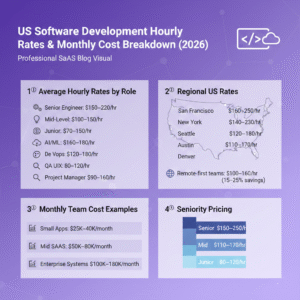
US development teams price their services based on technical complexity and market positioning. Senior Software Engineers charge $150-220 per hour , while Mid-Level Engineers range from $100-150 hourly. Junior Software Engineers start at $70-100 per hour. Specialized roles carry additional premiums: AI/ML Specialists command $160-250, DevOps Engineers bill $120-180, and UI/UX Designers charge $80-140 per hour. Project Managers typically fall within $90-160 hourly, with QA Engineers at $70-120.
2.1. Regional rate variations across US cities
Geographic location significantly impacts software development costs within the United States.San Francisco Bay Area tops the scale at $160-250 per hour, followed by New York City at $150-230. Seattle developers charge $140-210, while Austin rates range from $120-180. Denver represents a more moderate market at $110-170 per hour. Remote-first US teams deliver 15-25% savings compared to major tech hubs, typically billing $100-160 hourly while maintaining quality standards.
2.2. Monthly team costs for different project sizes
Small business applications requiring two mid-level engineers, a part-time designer, and a part-time project manager cost $25,000-40,000 monthly over 3-4 months. Mid-sized SaaS platforms need larger teams: one senior engineer, two mid-level engineers, a UI/UX designer, QA engineer, and a project manager run $50,000-80,000 per month across 6-8 months. Complex enterprise systems demand extensive resources: two senior engineers, three mid-level engineers, an AI/ML specialist, designer, two QA engineers, a project manager, and a DevOps engineer total $100,000-180,000 monthly for 10-14 months.
2.3. Onshore vs remote-first US teams
Remote-first models offer substantial custom software development cost reductions without offshore coordination challenges. Companies save 20-30% through hybrid approaches: US senior engineers handle core logic, offshore teams manage UI and QA, while US-based project managers maintain seamless communication.
2.4. Cost per developer seniority level
Seniority directly determines billing rates across all specializations. Junior developers charge $80-120 hourly, mid-level professionals bill $110-170, and senior specialists command $150-250 per hour. These brackets reflect experience-based productivity differences and architectural decision-making capabilities that justify the premium for seasoned engineers.
3. Custom software development cost by project complexity
Project complexity determines total investment more than any other variable in custom software development cost planning. Organizations allocating budgets between $80K and $2M+ face distinct technical requirements, team compositions, and delivery timelines across three primary tiers.

3.1. Simple business applications ($80K-$150K)
Basic internal tools serve single-purpose needs without complex backend architecture. A business management dashboard for a consulting firm tracking projects, invoices, and client documents typically costs $80,000-150,000 over 3-4 months. These applications include user authentication, simple databases, basic integrations with calendar and email systems, and mobile-responsive design. Simple custom software development projects generally range from $60,000-120,000, with straightforward feature sets and limited third-party connections.
3.2. Mid-sized SaaS platforms ($250K-$500K)
Multi-tenant architectures supporting moderate user volumes require sophisticated engineering. Mid-complexity platforms integrate payment processing through Stripe, implement role-based permissions, analytics dashboards, and custom UI/UX design. A fitness app with user profiles, workout tracking, and social features built cross-platform costs $120,000-250,000 over 4-6 months. SaaS applications at this tier typically fall between $250,000-500,000, demanding 6-8 month development cycles with teams of five to six specialists.
3.3. Complex enterprise systems ($800K-$2M+)
Mission-critical platforms serving large organizations justify substantial investment through compliance requirements and advanced functionality. Healthcare software requiring HIPAA compliance, patient portals, and legacy system integration reaches $300,000-600,000+. Enterprise systems handling multiple modules across inventory, finance, and HR with AI/ML integration over 10-14 months. These projects demand specialized expertise, rigorous security protocols, and architectural decisions supporting millions of users.cost $1,000,000-2,520,000
4. Hidden costs and budget planning strategies
Initial project estimates rarely account for mandatory certifications and recurring service fees that significantly alter software development cost breakdown calculations. Organizations discover these expenses during implementation, often forcing budget revisions or scope reductions.
4.1. Compliance certifications and legal fees
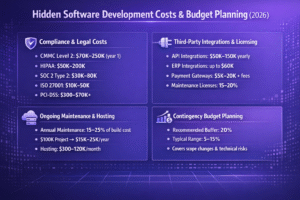
Regulatory requirements impose substantial upfront and ongoing costs. from $70,000-250,000 for the first year, while HIPAA compliance adds $50,000-200,000 to project budgets. SOC 2 Type 2 certification costs $30,000-80,000, with annual maintenance representing 40% of initial compliance expenses. ISO 27001 certification for startups and SMBs falls between $10,000-50,000. PCI-DSS compliance varies from $300 annually for small businesses to $70,000+ for large enterprises requiring onsite audits.CMMC Level 2 certification ranges
4.2. Third-party integrations and licensing
API integrations cost $50,000-150,000 annually when accounting for personnel and partnership fees. Simple API connections start at $2,000, while complex ERP integrations reach $60,000. Payment gateway integrations require $5,000-20,000 upfront plus ongoing transaction fees. Software maintenance fees typically equal 15-20% of license costs annually, with vendors increasingly charging 20% or more.
4.3. Ongoing maintenance and support costs
Annual maintenance consumes 15-25% of initial development investment. A $100,000 project requires $15,000-25,000 yearly for bug fixes, security updates, and compatibility maintenance. Hosting environments cost $300-120,000 monthly depending on redundancy requirements.
4.4. Setting realistic contingency buffers
Industry standards recommend 20% contingency budgets on development estimates. Contingency funds typically range from 5-15% of total project costs, protecting against scope changes, technical challenges, and requirement evolution without forcing feature sacrifices.
5. Conclusion
Accurate software development budgeting requires understanding rate variations, compliance overhead, and hidden maintenance costs that extend beyond initial estimates. Organizations should allocate 20% contingency buffers and calculate total cost of ownership rather than focusing solely on development phases. Above all, realistic planning accounts for regional differences, specialized talent premiums, and ongoing support obligations. Companies that factor these elements into their initial estimates avoid budget overruns and maintain project momentum throughout delivery cycles.
6. FAQs
Q1. What is the typical cost range for software development projects in 2026?
Software development costs vary significantly based on project complexity. Simple business applications typically cost between $80,000-$150,000, mid-sized SaaS platforms range from $250,000-$500,000, while complex enterprise systems can exceed $800,000 to $2 million or more. The final cost depends on factors like team composition, development timeline, and technical requirements.
Q2. Why are software development costs higher in the United States compared to other regions?
US software development costs are elevated due to several factors: high demand for specialized developers with median wages around $133,000, regional cost of living differences across major tech hubs, stringent compliance and quality requirements for regulated industries, and higher operational overhead including benefits packages that constitute 30% of total employee compensation.
Q3. What are the average hourly rates for software developers in the US?
Hourly rates vary by experience level and specialization. Junior developers charge $70-100 per hour, mid-level engineers bill $100-150 hourly, and senior engineers command $150-220 per hour. Specialized roles like AI/ML specialists can charge $160-250 per hour, while rates also vary by location, with San Francisco Bay Area reaching $160-250 per hour compared to more moderate markets like Denver at $110-170 per hour.
Q4. What hidden costs should be included in software development budgets?
Beyond development costs, organizations should budget for compliance certifications ($30,000-250,000 depending on requirements), third-party API integrations ($50,000-150,000 annually), ongoing maintenance (15-25% of initial development cost yearly), and licensing fees. Industry best practices recommend adding a 20% contingency buffer to account for scope changes and unforeseen technical challenges.
Q5. How much does it cost to maintain software after initial development?
Annual maintenance typically consumes 15-25% of the initial development investment. For example, a $100,000 project would require $15,000-25,000 yearly for bug fixes, security updates, and compatibility maintenance. Additionally, hosting environments can cost anywhere from $300 to $120,000 monthly depending on infrastructure and redundancy requirements.