







I hope you enjoy reading this blog post. If you want my team to help you grow your business,
Click here.
The shift toward distributed software teams is no longer a tactical cost-saving measure but a core component of modern enterprise scalability. Organizations increasingly leverage offshore talent to access specialized skill sets and maintain 24/7 development cycles. However, the transition from local to global delivery introduces complex layers of operational risk and communication overhead.

Successful execution requires shifting the perspective from “outsourcing tasks” to “integrating strategic partners.” When managed through a rigorous governance framework, offshore development becomes a high-velocity engine for innovation; without it, the model collapses under the weight of technical debt and misaligned expectations.
1. Delivery Models Compared: Identifying the Right Framework
Selecting a delivery model is a foundational architecture decision that dictates the long-term success of the engagement. Enterprises must balance control, cost, and agility based on their specific product roadmap.
| Model | Strategic Intent | Best For |
|---|---|---|
| Staff Augmentation | Bridging immediate capacity gaps. | Scaling existing teams quickly for specific sprints. |
| Dedicated Team | Long-term product ownership and continuity. | Core product development and architectural evolution. |
| Project-Based | Fixed-scope delivery with defined outcomes. | MVP development or clearly bounded legacy migrations. |
Strategic Implication: Organizations that fail to align the delivery model with their internal maturity often face friction in resource allocation. A dedicated team model, for instance, reduces architectural risk by ensuring the offshore developers maintain deep institutional knowledge of the codebase.
2. Establishing Architectural Governance and Technical Standards
In a distributed environment, technical drift is a significant threat to scalability. Modern software strategy dictates that governance must be proactive rather than reactive. Without unified standards, offshore teams may inadvertently introduce inconsistencies that complicate long-term maintenance.
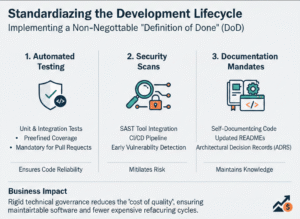
Standardizing the Development Lifecycle
Organizations should implement a “Definition of Done” (DoD) that is non-negotiable across geographic boundaries. This ensures that every line of code meets the enterprise’s security and quality benchmarks before it enters the production pipeline.
- Automated Testing Requirements: Every pull request must satisfy predefined unit and integration test coverage.
- Security Scans: Integration of SAST (Static Application Security Testing) tools within the CI/CD pipeline to mitigate vulnerabilities early.
- Documentation Mandates: Code must be self-documenting, supported by updated READMEs and architectural decision records (ADRs).
Business Impact: Rigid technical governance reduces the “cost of quality.” By enforcing these standards, leaders ensure that the software remains maintainable, reducing the need for expensive refactoring cycles in the future.
3. Strategic Communication and Synchronicity Frameworks
Managing offshore developers effectively requires overcoming the “information asymmetry” inherent in remote work. When teams operate across multiple time zones, reliance on synchronous communication (meetings) becomes a bottleneck.

Transitioning to Asynchronous Excellence
High-performing distributed teams prioritize asynchronous communication to maintain momentum. This involves moving beyond chat-based interactions toward structured, searchable documentation.
- Context-Rich Ticketing: Requirements should never be relayed verbally. Every task must be backed by a comprehensive user story, acceptance criteria, and technical constraints.
- Recorded Knowledge Sharing: Internal demos and technical walkthroughs should be recorded to serve as a library for onboarding and troubleshooting.
- The “Golden Hour” Strategy: Leaders must identify a 2-to-3-hour overlap window dedicated strictly to high-bandwidth collaborative tasks, such as architectural reviews or complex problem-solving.
Business Impact: Reducing dependency on real-time presence increases operational efficiency. It allows offshore teams to work autonomously, ensuring that the development engine continues to run even while the onshore headquarters is offline.
4. Mitigating Operational Risk through Cultural Integration
A common failure point in offshore team management is treating the remote unit as a “black box” of output. In modern software strategy, cultural alignment is a prerequisite for delivery excellence. If offshore developers do not understand the broader business context, their technical decisions may not align with the product’s strategic goals.
Fostering Product Ownership
Enterprises must involve offshore leads in the “Why” behind the “What.” Sharing the product roadmap and user feedback loops transforms developers from task executors into product contributors.
- Shared OKRs: Align the offshore team’s performance metrics with the company’s key business results.
- Direct Access to Stakeholders: Allow technical leads to communicate directly with product owners to clarify requirements, reducing the risk of “telephone game” errors.
Strategic Statement: When offshore teams feel a sense of ownership, they are more likely to identify technical risks early and propose architectural improvements that align with the long-term vision.
5. Performance Metrics and Delivery Transparency
Traditional metrics like “lines of code” are obsolete in high-stakes development. Organizations should evaluate offshore performance through the lens of delivery velocity and code health.
The Metrics Matrix for Decision-Makers
| Metric | Focus Area | Significance |
|---|---|---|
| Cycle Time | Agility | Measures the speed from "idea" to "production." |
| Change Failure Rate | Stability | Indicates the quality of the testing and deployment process. |
| Sprint Burndown | Predictability | Shows how accurately the team estimates and delivers. |
| Technical Debt Ratio | Sustainability | Evaluates long-term maintainability of the codebase. |
Strategic Implication: Data-driven management removes subjectivity from performance reviews. It allows CTOs to identify bottlenecks in the pipelinewhether they are technical hurdles or process-related delays and address them with precision.
Security and IP Protection in Global Environments
Managing remote development teams involves navigating diverse legal and security landscapes. Enterprises must protect their intellectual property (IP) through both legal frameworks and technical barriers.
Security Best Practices for Success
- Virtual Desktop Infrastructure (VDI): Implementing VDI ensures that sensitive code never resides on a developer’s local machine.
- Zero-Trust Architecture: Access to production environments and sensitive data should be granted on a “least-privilege” basis, validated continuously.
- Strict IP Clauses: Contracts must explicitly state that all work-for-hire belongs to the organization, governed by the jurisdiction most favorable to the enterprise.
Business Impact: A robust security posture is not just a defensive measure; it is a business enabler. It builds trust with end-users and stakeholders, ensuring that global expansion does not result in catastrophic data breaches or IP loss.
6. Evaluating the Maturity of Offshore Partners
For organizations seeking to scale, the choice of a consulting or development partner is a high-stakes architecture decision. A mature partner should act as a force multiplier, not just a source of headcount.
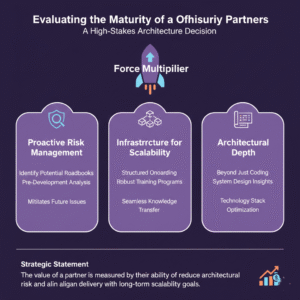
Key Indicators of a High-Maturity Partner:
- Proactive Risk Management: They identify potential roadblocks in requirements before development begins.
- Infrastructure for Scalability: They have established processes for onboarding, training, and knowledge transfer.
- Architectural Depth: They offer more than just coding; they provide insights into system design and technology stack optimization.
Strategic Statement: In high-risk product environments, the value of a partner is measured by their ability to reduce architectural risk and align delivery with the organization’s long-term scalability goals.
7. The Executive Blueprint for Global Success
Effective management of offshore developers is a discipline of structured governance, clear communication, and strategic alignment. It requires moving away from the “labor arbitrage” mindset toward a model of “integrated excellence.”
Leaders who successfully navigate this transition gain a significant competitive advantage: a global, high-velocity development engine capable of delivering complex software at scale. By implementing the frameworks of architectural governance, asynchronous communication, and performance transparency, organizations ensure that their offshore investments yield sustainable, high-impact business outcomes.
8. FAQs
What are the best tools to manage offshore developers remotely?
Effective management of global talent relies on a centralized “Source of Truth” to maintain transparency. Enterprises typically utilize Jira or Azure DevOps for robust project tracking and backlog management. For real-time collaboration, Slack and Microsoft Teams serve as the primary hubs, while GitHub or GitLab facilitates secure, version-controlled code sharing. The goal is to create a seamless digital workspace that bridges the physical distance.
How can leadership track the productivity of offshore software teams?
Productivity should be measured by delivery outcomes rather than activity logs. Organizations should focus on key performance indicators (KPIs) such as Sprint Velocity, Cycle Time, and Pull Request (PR) turnaround. By setting precise, measurable goals and using automated dashboards, leaders can ensure high performance and maintain accountability without counterproductive micromanagement.
How can daily stand-ups be improved across different time zones?
To maximize efficiency, teams should adopt a “Synchronicity Framework” that respects geographical gaps. This involves identifying a 2–3 hour window of overlapping work hours for high-priority discussions. For status updates, asynchronous tools like recorded video clips or dedicated Slack threads help reservelive meetings for solving complex blockers and architectural alignment.
What are the top project management platforms for offshore development?
The choice of platform depends on the complexity of the delivery model. Jira remains the industry standard for its deep integration with developer workflows. Asana and Monday.com are preferred for high-level product road mapping and cross-functional visibility. For smaller, high-velocity teams, Linear offers a streamlined, performance-oriented alternative that reduces administrative overhead.
What strategies foster team cohesion with offshore developers?
- Context Sharing: Regularly brief offshore teams on business vision and product impact.
- Direct Access: Encourage open communication between offshore leads and onshore product owners.
- Virtual Integration: Include distributed members in All Hands meetings and social syncs.
Which tools ensure secure code sharing with external teams?
Security is a non negotiable pillar of offshore management. Secure delivery is facilitated through enterprise-grade Git repositories with strict Access Control Lists (ACLs). Implementing VPNs and Zero-Trust network access helps protect intellectual property within a controlled perimeter.
Where can organizations find reliable management software or consulting?
Enterprises seeking to establish or optimize an Offshore Development Center (ODC) should consider consulting partners with specialized expertise. These services provide strategic blueprints for governance models, compliance, and talent acquisition. Many organizations leverage analyst reports to identify top-tier platforms and consulting firms with proven global delivery experience.
![Read more about the article Why Your Software Project Needs a Dedicated Development Team in 2026 [Expert Guide]](https://pods365.com/wp-content/uploads/2026/02/Blog-Banner-for-Website-Content-3-300x169.png)