





Enterprise leaders often ask the same question: how long does it really take to build enterprise software? The truth is that there is no single universal timeframe. A small internal tool may take a few months, while a complex enterprise platform involving integrations, compliance, and scaling requirements can take over a year.
An enterprise software development timeline depends on several key factors, including team size, business goals, technology stack, and workflow complexity. Unlike consumer apps, enterprise systems must handle large data volumes, security layers, and long-term scalability. That’s why understanding software development phases is critical before estimating timelines.
Think of enterprise development like constructing a smart building. You don’t just build walls, you plan infrastructure, safety, automation, and future upgrades. Similarly, enterprise apps go through structured SDLC stages, testing cycles, deployment planning, and continuous maintenance.
This guide explains the full timeline using a simple numbered process so decision-makers can realistically understand how enterprise software development progresses from idea to launch and beyond.

1. Discovery & Planning (2–6 Weeks)
The first phase defines what needs to be built and why. During discovery, stakeholders identify goals, target users, core features, and business constraints. This stage sets the foundation of the entire enterprise software development timeline.
Teams typically conduct workshops, competitor analysis, and technical feasibility checks. For example, a logistics company planning a fleet-management platform might define real-time tracking, analytics dashboards, and integration with ERP systems during this stage.
Key activities include:
- Requirements gathering
- Initial architecture decisions
- Budget and resource planning
- Risk assessment
Without strong discovery, projects often suffer from scope creep later. Many enterprises underestimate this phase, yet it directly impacts delivery speed. A well-planned discovery stage reduces rework during development and shortens the overall custom software timeline.
Mini Scenario:
A retail enterprise skipped discovery and started coding quickly. Six weeks later, they realized compliance requirements were missing, forcing a redesign that added three months to delivery.

2. System Design & Architecture (3–8 Weeks)
Once goals are defined, teams move into system design. This phase translates business requirements into technical blueprints databases, microservices, APIs, and infrastructure planning.
Architecture decisions heavily influence the enterprise software development timeline. Choosing cloud-native architecture or modular microservices can accelerate future scaling, while poor design creates long-term technical debt.
Common design tasks include:
- High-level system architecture diagrams
- Data flow modeling
- Security and compliance planning
- UI/UX wireframes
Enterprise applications require scalability from day one. For instance, a banking analytics platform must handle millions of transactions while maintaining strict security standards.
Architecture Checklist
| Design Area | Questions to Answer |
|---|---|
| Scalability | Can the system handle 10× user growth? |
| Security | Are encryption and access controls defined? |
| Integration | Will APIs connect with existing tools? |
| Performance | Is cloud infrastructure optimized? |
Strong architecture reduces delays later during testing and deployment a crucial factor in controlling enterprise timelines.
3. UI/UX Design & Prototyping (3–6 Weeks)
Before full development begins, design teams create user journeys, dashboards, and interaction flows. Enterprise software often supports multiple roles, administrators, managers, and analysts, so usability planning is essential.
A well-designed interface shortens training time and improves adoption after launch. This stage includes:
- Interactive prototypes
- Workflow mapping
- Usability testing with stakeholders
For example, an HR enterprise system may prototype onboarding workflows, payroll dashboards, and employee self-service portals.
Although UI design might seem separate from engineering, it directly impacts the enterprise software development timeline. Early prototypes prevent costly redesigns during development.
Mini Scenario:
A manufacturing firm tested its dashboard prototype with operations managers. Feedback revealed confusing navigation, allowing designers to fix issues before development started saving weeks of rework.
4. Development & Iteration (3–8+ Months)
Development is usually the longest stage of the enterprise software development timeline. Engineers build backend services, databases, APIs, and frontend interfaces while following agile sprint cycles.
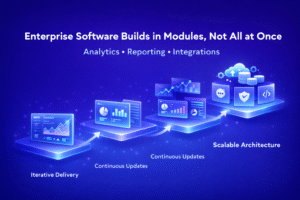
Enterprise projects rarely develop everything at once. Instead, teams release incremental modules analytics, reporting, integrations through iterative releases.
Typical tasks include:
- Backend engineering
- Frontend development
- API integrations
- Cloud configuration
- Code reviews
Because enterprise software development involves large systems, collaboration between developers, product managers, and QA teams is constant.
Development Timeline Snapshot
| Complexity Level | Typical Development Duration |
|---|---|
| Internal enterprise tool | 3–5 months |
| Mid-scale SaaS platform | 6–9 months |
| Large enterprise ecosystem | 9–18 months |
The key to keeping timelines predictable is breaking development into manageable sprints rather than building everything at once.
5. Testing & Quality Assurance (4–8 Weeks, Ongoing)
Testing ensures that enterprise apps are secure, reliable, and scalable. Unlike consumer software, enterprise platforms must pass strict performance and security validations.
Testing includes:
- Functional testing
- Load and performance testing
- Security audits
- User acceptance testing
This stage plays a huge role in refining the enterprise software development timeline because bugs discovered late can delay releases significantly.
Example:
An enterprise analytics platform passed functional testing but failed under heavy load during performance testing. Engineers optimized database queries before deployment, preventing downtime after launch.
Quality assurance is not a single step,it runs alongside development. Continuous testing helps teams detect problems early, saving both time and cost.
6. Deployment & Launch (2–4 Weeks)
Deployment is where enterprise software moves from development environments to live production systems. This phase involves infrastructure setup, monitoring tools, and rollback planning.
Modern enterprises often use CI/CD pipelines to automate deployment. Key deployment tasks include:
- Cloud infrastructure provisioning
- Data migration
- User onboarding setup
- Monitoring and logging configuration
A well-structured deployment strategy ensures minimal disruption to existing business processes. For example, a healthcare platform might roll out new features gradually across regions to reduce risk.
The enterprise software development timeline can expand if deployment planning is overlooked, especially when dealing with legacy integrations or compliance checks.
7. Maintenance, Optimization & Scaling (Ongoing)
Enterprise software is never truly “finished.” After launch, teams continue improving performance, fixing bugs, and adding features based on user feedback.
Maintenance activities include:
- Performance monitoring
- Security updates
- Feature enhancements
- System scaling
Many organizations spend more time on maintenance than on initial development. According to industry observations, post-launch optimization often represents a large portion of long-term enterprise investment.
Mini Scenario:
A fintech company launched a risk-analysis platform successfully, but after six months of usage, data volume doubled. Scaling the infrastructure became the next phase of development, showing how the timeline continues beyond launch.
Understanding this final phase helps leaders plan realistic expectations for enterprise software development.
8. Realistic Timeline Overview
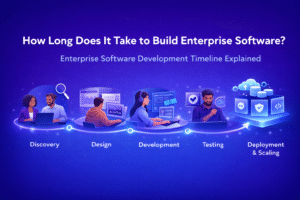
Here’s a simplified breakdown combining all software development phases:
| Stage | Estimated Duration |
|---|---|
| Discovery & Planning | 2–6 weeks |
| Architecture & Design | 3–8 weeks |
| UI/UX Prototyping | 3–6 weeks |
| Development | 3–8+ months |
| Testing & QA | 4–8 weeks |
| Deployment | 2–4 weeks |
| Maintenance | Continuous |
Total typical enterprise software development timeline: 6–18 months, depending on complexity and integrations.
9. Why Timelines Vary
There is no universal answer to how long enterprise software takes to build. A realistic enterprise software development timeline depends on business goals, technical scope, and team collaboration. The most successful organizations treat development as a structured journey through SDLC stages rather than a rush to launch.
By understanding each phase of discovery, architecture, development, testing, deployment, and maintenance, decision-makers can plan budgets and expectations more effectively. Enterprise apps succeed when teams prioritize clarity, iterative progress, and long-term scalability instead of quick wins.
10. FAQ: Enterprise Software Development Timelines
What are the 7 stages of enterprise development?
MG Taylor Corporation (1996) articulated seven stages of enterprise growth and development. The stages include conception, looping, success, overshoot and collapse, entrepreneurial button, maturity, turnaround, and death. While originally a business-evolution framework, many enterprise software teams align their enterprise software development timeline with similar lifecycle thinking — moving from early concept validation through scaling, optimization, and eventual transformation or replacement of systems.
What are the 5 stages of enterprise software development?
Industry SDLC models commonly describe five core stages of enterprise software development: planning, design, development, testing, and deployment. According to structured enterprise engineering practices, planning defines requirements, design establishes architecture, development builds functionality, testing validates quality and security, and deployment transitions the system into production environments. Maintenance and optimization typically continue as iterative extensions of these phases within enterprise ecosystems.
What are the 7 phases of SDLC?
Traditional Software Development Life Cycle (SDLC) frameworks referenced in IEEE and ISO software engineering standards define seven phases: planning, requirements analysis, system design, implementation, testing, deployment, and maintenance. These phases provide a structured roadmap that aligns directly with an enterprise software development timeline, ensuring scalability, risk control, and long-term system stability across complex enterprise applications.
What is the 80 20 rule in software development?
The 80/20 principle, derived from Vilfredo Pareto’s distribution theory (1896) and later applied to software engineering productivity models, states that roughly 20% of features generate 80% of business value. In enterprise software development, teams use this concept to prioritize high-impact functionality early in the timeline, reduce unnecessary complexity, and accelerate delivery while maintaining strategic focus on core outcomes.

PODS365 Expert Team
This blog is prepared by the PODS365 Expert Team, a collective of enterprise software specialists focused on architecture, SDLC strategy, and large-scale development timelines. The insights shared reflect real-world enterprise engineering practices and industry-backed methodologies.

![Read more about the article Why Your Software Project Needs a Dedicated Development Team in 2026 [Expert Guide]](https://pods365.com/wp-content/uploads/2026/02/Blog-Banner-for-Website-Content-3-300x169.png)