





![You are currently viewing Why Your Software Project Needs a Dedicated Development Team in 2026 [Expert Guide]](https://pods365.com/wp-content/uploads/2026/02/Blog-Banner-for-Website-Content-3.png)

I hope you enjoy reading this blog post. If you want my team to help you grow your business,
click here.
Software development dedicated teams have become the strategic choice for companies seeking long-term partnerships for their digital initiatives. A dedicated development team is a group of remote developers hired to work exclusively on a specific product or project. Instead of juggling freelancers or struggling with in-house recruitment, companies can establish full-featured teams within weeks, complete with proven skills and ready to tackle complex challenges.

Hiring a dedicated development team offers significant advantages over traditional approaches. With a dedicated software development team, companies can define requirements as they build, following an iterative process of creating, testing, and refining that aligns perfectly with Agile methodologies. Additionally, this model eliminates many expenses associated with in-house teams, such as salaries, office space, recruitment costs, and benefits. Although freelancers might seem appealing for short-term solutions, they typically prove less reliable for long-term projects.
The dedicated development team model isn’t just another outsourcing option, it’s a full partnership where a ready-made team is customized to specific needs. Rather than purchasing a temporary solution, companies that hire dedicated development teams are essentially building something that grows with them over time. This approach is particularly valuable for complex projects with evolving requirements, where adaptability and continuous collaboration determine success.
1. What is a Dedicated Development Team?
A dedicated development team represents a strategic extension of a company’s internal resources, comprised of software professionals who work exclusively on a specific project or product. Unlike temporary arrangements, this team becomes deeply integrated with a client’s business objectives, technology vision, and long-term growth plans.
Definition and core concept
The dedicated team model involves assembling a self-sufficient group of specialists who focus solely on a client’s project while working full-time. This arrangement creates what is effectively an integrated outpost that operates under the client’s direction and adapts to their workflows. The vendor handles operational aspects like recruitment, employee retention, office space, and infrastructure, while the client maintains control over the software development lifecycle. Furthermore, this model allows companies to tap into talent pools in regions with competitive development rates, such as Eastern Europe, Asia, or Latin America.
How it differs from freelancers and outsourcing
The dedicated development team model stands apart from both freelancing and traditional outsourcing in several key ways. In contrast to freelancers who typically juggle multiple projects simultaneously, dedicated team members work exclusively for one client. While freelancers excel at specific, bounded tasks with clear specifications, they often struggle with orchestration and continuity on complex projects.
Moreover, unlike traditional outsourcing where teams handle multiple clients and offer limited control, dedicated teams provide full ownership over workflows, priorities, and development processes. The client decides how the project runs, who leads it, and how performance is measured, creating a relationship based on long-term collaboration without long-term employment commitments. Consequently, this model offers stability and accountability that short-term arrangements cannot match.
Typical team structure and roles
A well-designed software development team structure balances expertise with focus, ensuring every task has clear ownership. Most dedicated teams include:
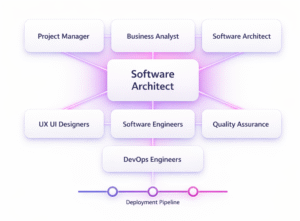
This structure ensures clarity of ownership, faster alignment, and predictable delivery while maintaining knowledge continuity across releases.
2. Why Your Project Needs a Dedicated Team in 2026
In 2026, speed and innovation remain critical factors for business survival. Companies that leverage dedicated software development teams gain significant competitive advantages over those relying solely on in-house resources or traditional outsourcing.
Faster time-to-market with focused teams
Dedicated teams dramatically reduce product launch timelines by 20-40% compared to conventional development approaches. This acceleration occurs because team members work exclusively on your project, eliminating the productivity losses that come from context switching. Studies show that high-performing dedicated teams deliver updates far more frequently than their counterparts. Furthermore, companies utilizing performance metrics have reduced project delays by up to 25%. This singular focus leads to shorter turnaround times and streamlined workflows that are especially valuable when facing tight deadlines.
Better alignment with long-term goals
When teams understand how their work connects to company objectives, projects finish on time and resources are directed where they’ll have maximum impact. Dedicated development teams operate as extensions of your organization, integrating directly into your workflows and adopting your tools, sprint rituals, and processes. Through this deep integration, they accumulate valuable product knowledge, architectural insight, and customer context. This alignment eliminates the friction that occurs when departments work at cross-purposes, a common issue when one team prioritizes speed while another emphasizes accuracy.

Improved code quality and maintainability
Poor code quality often leads to delays, bugs, and increased maintenance costs. Research indicates discovering bugs after production can be ten times more expensive than catching them earlier. A dedicated team builds deep product knowledge over time, improving stability, velocity, and long-term continuity. Their accumulated expertise helps reduce technical debt and improve release stability, resulting in more reliable outcomes.
Scalability without HR overhead
Dedicated teams offer remarkable flexibility to scale resources based on project requirements. You can expand during high-velocity phases or reduce team size once a product stabilizes, all without internal restructuring. This adaptability helps eliminate the financial burden of maintaining underutilized resources during slow periods. Most impressively, dedicated development teams can reduce costs by 30-60% by eliminating infrastructure, benefits, and recruitment expenses.
3. When to Hire a Dedicated Development Team
Identifying the right moment to hire a dedicated development team is crucial for project success. According to research, 92% of Global 2000 companies now engage external talent in their projects. Here are the key scenarios where this approach makes the most sense:
Early-stage startups building MVPs
Startups face a critical challenge: bringing products to market quickly without over-hiring. A software development dedicated team provides the perfect solution for MVP development, offering 2-3x faster ramp-up compared to in-house hiring. This approach enables startups to validate ideas quickly, gather user feedback, and iterate accordingly—all without committing to permanent hires before product validation. Indeed, at the MVP stage, uncertainty is the biggest cost factor.
Projects with evolving or unclear requirements
When requirements are fluid, a dedicated team becomes invaluable. These teams excel in environments where scope changes frequently, working in small increments to incorporate regular feedback. For projects with ambitious timelines or changing specifications, dedicated teams can adjust priorities without extensive renegotiation, a stark contrast to fixed-scope contracts.
Long-term or complex software products
Complex projects implementing various technologies benefit significantly from dedicated development teams. Their expertise proves essential for applications requiring continuous updates, ongoing maintenance, or deep technical knowledge. Specifically, 75% of digital transformation initiatives fail due to execution gaps rather than innovation shortfalls.
When internal teams are overloaded
Nearly 26% of small businesses face skill gaps that hamper growth. Whenever in-house developers become overwhelmed, a dedicated development team can seamlessly integrate into existing workflows, providing additional capacity without disrupting operations. This approach lets companies scale quickly without forcing internal teams to stretch beyond their limits.
4. How to Build and Manage a Dedicated Team
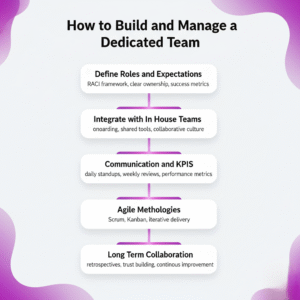
Building an effective software development dedicated team involves several strategic steps that go beyond just hiring talent. First of all, success depends on careful planning, clear communication, and thoughtful integration.
Define roles and expectations clearly
Misalignment often begins with ambiguous responsibilities. Document specific roles, deliverables, and success metrics for each team member. Using frameworks like RACI (Responsible, Accountable, Consulted, Informed) helps prevent task overlap and reduces friction between teams. This clarity enables smoother collaboration and establishes accountability across the project lifecycle.
Integrate with your in-house team
Dedicated teams should never feel like outsiders. Schedule comprehensive onboarding sessions that include knowledge transfer, tool access setup, and cultural immersion. Make sure they’re involved in regular team meetings and company-wide communications to foster alignment and inclusion. Creating overlapping work hours ensures real-time collaboration despite time zone differences.
Set up communication and KPIs
Establish structured communication rhythms with:
- Daily stand-ups for quick updates and blocker identification
- Weekly reviews for deeper progress discussions
- Dedicated channels for different types of communication
Meanwhile, track performance using meaningful metrics like delivery velocity, code quality, and issue resolution times.
Use agile methodologies for flexibility
Agile practices like Scrum and Kanban promote adaptability through iterative development. These methodologies enable teams to respond quickly to changing requirements, maintain transparency, and deliver consistent value. Subsequently, they foster better alignment between business goals and development efforts.
Foster long-term collaboration
Trust-building is pivotal for sustained success. Schedule regular retrospectives using frameworks like “Start, Stop, Continue” to continuously improve processes. Furthermore, recognize collaborative efforts and celebrate team successes to create a positive environment that values teamwork and shared accomplishments.
5. Conclusion
The dedicated development team model stands as a powerful solution for companies facing complex software challenges in 2026 and beyond. This approach offers substantial benefits compared to traditional models, including accelerated time-to-market, deep alignment with business objectives, superior code quality, and flexible scaling capabilities. Companies can reduce costs significantly while gaining access to specialized expertise that would otherwise require extensive recruitment efforts.
Though many businesses still hesitate to adopt this model, the evidence clearly demonstrates its effectiveness across various scenarios. Early-stage startups benefit from rapid MVP development without permanent hiring commitments. Projects with fluid requirements thrive under the adaptability of dedicated teams. Complex software initiatives gain the stability and deep product knowledge that only consistent, focused teams can provide.
Success with dedicated teams depends primarily on thoughtful implementation. Clear role definition establishes accountability from day one. Deliberate integration efforts break down barriers between remote and in-house teams. Regular communication rhythms and meaningful KPIs ensure everyone stays aligned despite physical distance. Agile methodologies provide the framework for continuous adaptation, while intentional trust-building creates sustainable partnerships.
As digital transformation continues reshaping industries, the ability to build and deploy software efficiently becomes increasingly crucial for competitive advantage. The dedicated development team model offers a strategic solution that balances quality, speed, and cost-effectiveness. Companies that embrace this approach position themselves to respond more nimbly to market changes and customer needs without sacrificing engineering excellence.
Dedicated development teams represent far more than just a staffing solution—they function as true extensions of a company’s vision and capabilities. This collaborative approach enables businesses to overcome resource limitations, accelerate innovation cycles, and maintain consistent quality throughout the software development lifecycle. Forward-thinking organizations will undoubtedly continue adopting this model as they navigate the increasingly complex digital landscape of 2026.
6. Key Takeaways
Dedicated development teams offer a strategic advantage for software projects in 2026, providing focused expertise, cost efficiency, and scalable solutions that traditional hiring models can’t match.
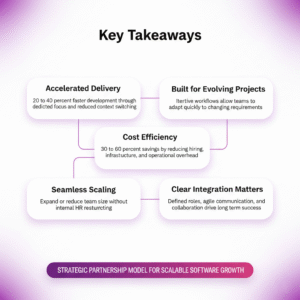
The dedicated development team model isn’t just outsourcing; it’s building a strategic partnership that grows with your business, combining the expertise of specialized professionals with the flexibility to adapt to changing market demands and project requirements.
FAQs
Q1. What is a dedicated development team, and how does it differ from other outsourcing models?
A dedicated development team is a group of remote professionals who work exclusively on your project, acting as an extension of your in-house team. Unlike traditional outsourcing, this model offers deeper alignment with your goals, focused expertise, and greater control over the development process.
Q2. When is it appropriate to hire a dedicated development team?
Hiring a dedicated team is ideal for early-stage startups building MVPs, projects with evolving requirements, long-term or complex software products, and when internal teams are overloaded. This approach offers flexibility, scalability, and specialized expertise without the commitment of permanent hires.
Q3. How can a dedicated development team improve project outcomes?
Dedicated teams can accelerate time-to-market by 20–40%, improve code quality and maintainability, and reduce costs by 30–60%. They offer better alignment with long-term goals, accumulated product knowledge, and the ability to scale resources without HR overhead.
Q4. What roles typically make up a dedicated development team?
A typical dedicated team includes a project manager, business analyst, software architect, UX/UI designers, software engineers (frontend and backend), quality assurance specialists, and DevOps engineers. This structure ensures clear ownership and predictable delivery across all aspects of software development.
Q5. How can companies effectively manage a dedicated development team?
To manage a dedicated team effectively, companies should clearly define roles and expectations, integrate the team with in-house staff, establish regular communication channels and KPIs, implement agile methodologies, and foster long-term collaboration. This approach helps build trust and ensures alignment with business objectives.