





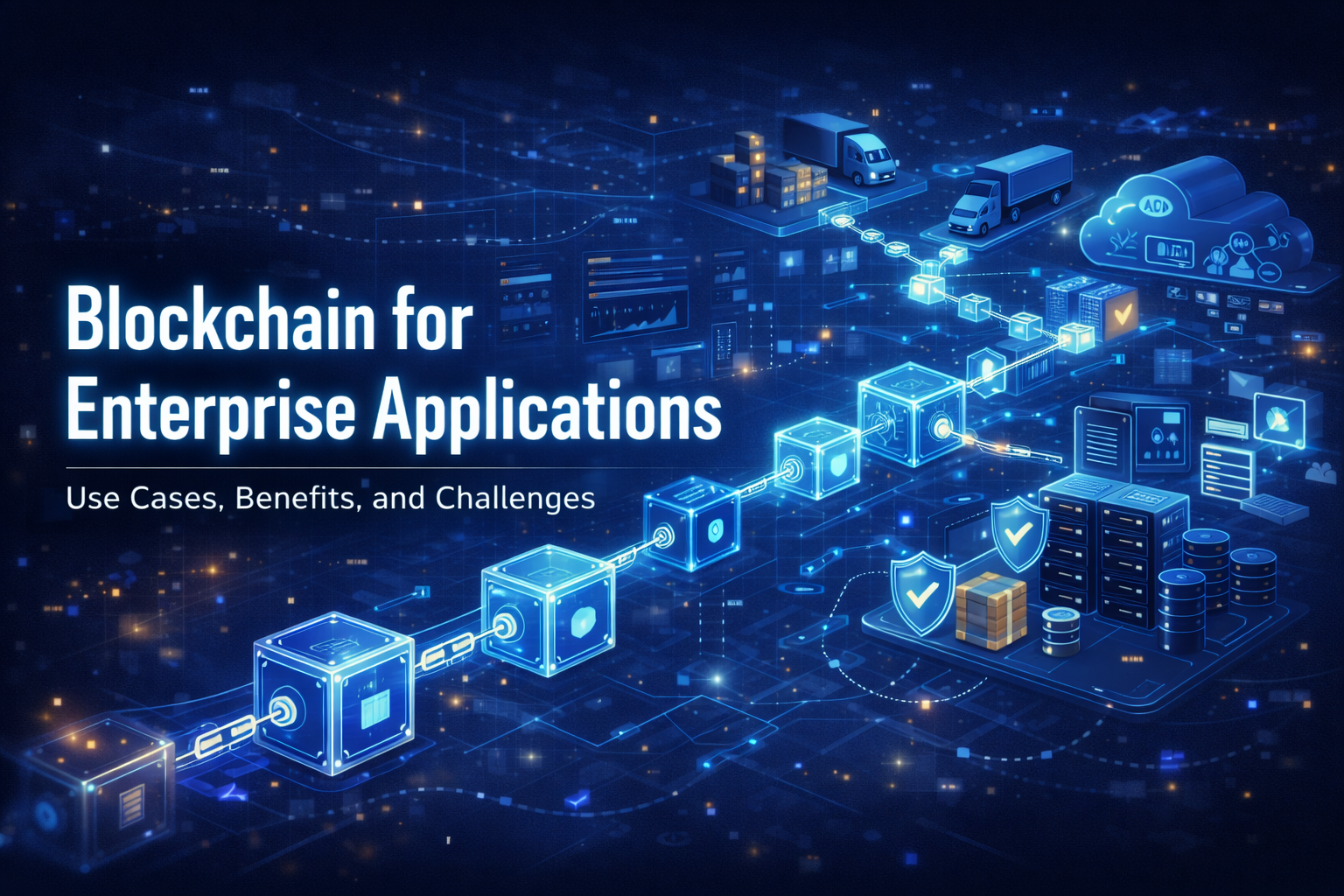
Modern enterprises handle massive amounts of transactions, data exchanges, and multi-party collaborations. Traditional centralized systems often struggle with issues such as data inconsistencies, trust gaps between organizations, slow reconciliation processes, and security vulnerabilities.
This is where blockchain for enterprise applications becomes relevant. Blockchain technology provides a distributed ledger where transactions are validated by a network rather than a central authority. Every entry becomes permanent, traceable, and cryptographically secure.
For enterprises, this means a new way to manage data integrity, automate workflows, and improve transparency across complex business ecosystems. Instead of multiple organizations maintaining separate databases, blockchain enables a shared and synchronized record of transactions.
The adoption of blockchain for enterprise applications has expanded across industries such as finance, logistics, healthcare, and government services. Enterprises use blockchain platforms to build secure digital infrastructure that supports cross-organizational collaboration and trust.
However, implementing enterprise blockchain systems is not simply about deploying new technology. It involves structured blockchain software development, integration with existing enterprise apps, careful testing, and long-term maintenance.
To understand how enterprises implement blockchain successfully, it is useful to examine the process in structured stages.
The Enterprise Blockchain Development Process
Organizations adopting blockchain for enterprise applications usually follow a structured development lifecycle similar to traditional software development. The process involves multiple phases—from identifying business problems to deploying blockchain networks and maintaining them over time.
Below are the seven stages commonly involved in building enterprise blockchain solutions.
1. Identifying the Business Problem
The first step in implementing blockchain for enterprise applications is identifying whether blockchain is actually necessary.
Many organizations initially approach blockchain as a trend rather than a solution to a specific problem. However, blockchain works best in scenarios involving multiple parties who must share trusted data without relying on a central authority.
Typical enterprise scenarios include:
Supply chain tracking
Financial transaction settlements
Digital identity verification
Asset ownership tracking
Cross-organization data sharing
For example, a global food retailer may struggle to trace the origin of contaminated products. Traditional systems require manual verification across suppliers and distributors. A blockchain ledger could record every stage of the supply chain, allowing companies to trace product origins within seconds instead of days.
During this stage, enterprises evaluate whether decentralization actually reduces cost, improves transparency, or eliminates intermediaries. If blockchain does not solve a real operational problem, traditional databases may be more efficient.
This problem-definition stage sets the foundation for successful enterprise blockchain solutions.
2. Designing the Blockchain Architecture
Once the business use case is validated, architects design the technical structure of the blockchain system.
The architecture determines how the network operates, who participates, and how data is validated. This stage plays a critical role in the success of blockchain for enterprise applications.
Key design decisions include:
Choosing the blockchain type
Public blockchain
Private blockchain
Consortium blockchain
Hybrid blockchain
Defining network participants
Enterprises
Suppliers
Customers
Regulators
Selecting consensus mechanisms
Proof of Authority
Proof of Stake
Practical Byzantine Fault Tolerance (PBFT)
Enterprise systems often prefer permissioned blockchains where only authorized participants can access the network. This structure helps maintain privacy while still providing distributed trust.
During architecture planning, developers also design smart contracts, APIs, and integrations with enterprise apps such as ERP or CRM platforms.
These technical decisions strongly influence the scalability, security, and governance of blockchain for enterprise applications.

3. Blockchain Software Development
The development phase involves building the core blockchain application and related infrastructure.
Teams start writing smart contracts, developing APIs, and integrating blockchain nodes with enterprise systems. This stage represents the most technically demanding part of blockchain software development.
Key development tasks include:
Writing smart contracts to automate business rules
Building blockchain nodes and network infrastructure
Developing user interfaces for enterprise apps
Creating integration layers with existing systems
For example, a financial institution building a blockchain-based settlement platform may create smart contracts that automatically verify transactions and trigger payments once predefined conditions are met.
Smart contracts reduce manual intervention and automate complex workflows, improving operational efficiency and reducing administrative overhead.
However, development requires specialized expertise in cryptography, distributed systems, and blockchain frameworks. This shortage of skilled developers often increases project costs and timelines.
As a result, enterprises typically combine blockchain specialists with traditional software engineers during this stage.
4. Testing and Security Validation
Before deployment, enterprise blockchain systems undergo extensive testing.
Testing is critical because blockchain networks are difficult to modify after deployment. Any vulnerability in smart contracts or consensus mechanisms could compromise data integrity.
Testing for blockchain for enterprise applications usually includes several layers.
Smart contract testing
Ensures automated logic works correctly
Prevents financial or operational errors
Security testing
Identifies vulnerabilities in cryptographic functions
Tests protection against hacking or unauthorized access
Integration testing
Verifies compatibility with enterprise apps
Ensures data synchronization across systems
Performance testing
Measures transaction speed and network scalability
Enterprise blockchains must support large transaction volumes. Without optimization, blockchain networks can experience slower transaction speeds due to complex consensus mechanisms.
Testing ensures that enterprise blockchain systems remain reliable under real-world operational conditions.
5. Deployment and Network Launch
Once testing is completed, the blockchain system is deployed into production environments.
Deployment for blockchain for enterprise applications typically involves launching blockchain nodes across participating organizations.

Steps in deployment usually include:
Setting up blockchain nodes
Configuring network permissions
Deploying smart contracts
Migrating existing data
Connecting enterprise applications
In enterprise environments, deployment may occur gradually. Organizations often begin with a pilot project before expanding the blockchain network to additional partners.
For example, a logistics company may initially deploy blockchain tracking for one shipping route. After validating performance and reliability, the network can scale across global operations.
Deployment also requires training stakeholders to interact with blockchain systems, especially when multiple organizations participate in a shared ledger.
6. Integration with Enterprise Systems
A critical stage in implementing blockchain for enterprise applications involves integrating the blockchain platform with existing enterprise infrastructure.
Most organizations already operate complex systems such as ERP platforms, CRM software, inventory systems, and analytics tools. Blockchain solutions must interact with these technologies seamlessly.
Integration tasks include:
Connecting APIs between blockchain and enterprise apps
Synchronizing transaction data across systems
Ensuring compatibility with legacy databases
Implementing secure identity management
Integration can be technically challenging because legacy systems often lack compatibility with decentralized architectures.
Enterprises must design middleware layers or integration services that translate data between traditional systems and blockchain networks.
This stage ensures that blockchain solutions complement existing workflows rather than disrupt them.
7. Maintenance and Continuous Optimization
The final stage of blockchain for enterprise applications is ongoing maintenance and improvement.
Like any enterprise software system, blockchain networks require continuous updates, monitoring, and governance.
Maintenance activities include:
Monitoring network performance
Updating smart contracts
Improving scalability
Applying security patches
Expanding network participants
Blockchain networks also evolve as standards and protocols mature. Because blockchain technology is still developing, enterprises must frequently update systems to maintain compatibility with new frameworks.
Organizations also monitor regulatory changes that affect blockchain adoption, especially in industries such as finance or healthcare.
Continuous improvement ensures that enterprise blockchain systems remain secure, scalable, and aligned with business goals.
Key Use Cases of Blockchain in Enterprise Applications
The practical value of blockchain for enterprise applications becomes clearer when examining real business use cases.
Supply Chain Management
Blockchain provides full transparency across supply chains. Every transaction—from manufacturing to delivery—can be recorded on a distributed ledger.
This allows enterprises to:
Track product origins
Verify authenticity
Reduce counterfeiting
Improve logistics coordination
Financial Transactions
Banks and financial institutions use blockchain to process cross-border payments and settlements faster.
Blockchain reduces transaction processing times and eliminates intermediaries, improving efficiency in global financial networks.
Healthcare Data Management
Healthcare organizations use blockchain to manage patient records securely while maintaining privacy controls.
Blockchain ensures that medical records remain tamper-proof while allowing authorized professionals to access them when necessary.
Digital Identity Systems
Governments and enterprises can create decentralized identity systems that allow individuals to control their personal data securely.
Insurance Claims Automation
Insurance companies use blockchain smart contracts to automatically process claims, reducing fraud and administrative costs.
These examples demonstrate how enterprise blockchain solutions address trust, transparency, and automation challenges across industries.
Benefits of Blockchain for Enterprise Applications
Organizations adopt blockchain for enterprise applications because it offers several operational advantages.
Improved Security
Blockchain uses cryptographic techniques and distributed validation to protect enterprise data from tampering or unauthorized access.
Transparency and Auditability
Every transaction recorded on a blockchain becomes part of a permanent audit trail, improving regulatory compliance and accountability.
Reduced Operational Costs
Smart contracts automate workflows and eliminate intermediaries, reducing administrative overhead and operational costs.
Faster Transactions
Blockchain enables near real-time transaction processing across multiple organizations, improving efficiency.
Increased Trust Between Organizations
Shared ledgers ensure that all participants access the same verified data, reducing disputes and reconciliation efforts.
Challenges of Enterprise Blockchain Adoption
Despite its benefits, implementing blockchain for enterprise applications also presents several challenges.
Integration with Legacy Systems
Enterprise IT infrastructure often includes legacy systems that are difficult to connect with blockchain platforms.
Scalability Limitations
Blockchain networks can experience slower transaction speeds when handling high volumes of data.
Regulatory Uncertainty
Legal frameworks for blockchain vary across countries and industries, creating compliance challenges for enterprises.
High Implementation Costs
Developing and maintaining blockchain infrastructure requires specialized expertise and infrastructure investment.
Governance Complexity
When multiple organizations share a blockchain network, establishing governance rules and decision-making processes can be difficult.
Understanding these challenges helps enterprises design realistic blockchain adoption strategies.
FAQ
What is the enterprise application of blockchain?
Enterprise applications of blockchain include supply chain tracking, financial settlements, digital identity systems, healthcare data management, and automated insurance claims. These systems use blockchain to create transparent and secure shared ledgers between organizations.
What is an enterprise blockchain?
An enterprise blockchain is a permissioned blockchain network designed for business use. Unlike public blockchains, access is restricted to authorized participants such as organizations, regulators, or partners.
What are the 4 types of blockchain?
The four main types of blockchain are public blockchains, private blockchains, consortium blockchains, and hybrid blockchains. Each type offers different levels of decentralization, security, and access control.
What are the applications of blockchain in business?
Blockchain applications in business include supply chain management, cross-border payments, asset tokenization, smart contracts, digital identity systems, and transparent auditing systems.
Conclusion
The rise of blockchain for enterprise applications reflects a broader shift toward decentralized digital infrastructure. Enterprises increasingly rely on blockchain to improve transparency, automate workflows, and establish trust across complex business networks.
However, blockchain adoption requires careful planning, structured blockchain software development, and strong integration with existing enterprise systems. Organizations must evaluate real use cases, design scalable architectures, and address regulatory challenges before deploying enterprise blockchain solutions.
When implemented strategically, blockchain technology can transform how enterprises manage data, collaborate with partners, and build secure digital ecosystems.